First, I would like to offer thanks to the military veterans today, November 11. I am remembering my dad, Milton Alexander, who was a veteran who was stationed in Germany in the 1950’s. He didn’t talk much about his service, but he did frequently remark on the painful amount of waiting around that his service required.
Is the current political situation one of a similar, painful period of waiting? Is the 2020 election about waiting to wake up from a nightmare? Or waiting to wake up from a pervasive darkness, a medieval version of American life? At least one pundit said it’s a particular president who has brought darkness, but I don’t believe he could have done it without help over time.

If we are in darkness, there’s an interesting assumption there. The assumption is that we know what the light looks like. I’m not so sure we do, in the context of knowing what a fully realized free country looks like.
Also, it’s one thing to know what the light is, but it’s another thing to have the power to turn it on, to bring freedom into being for all.
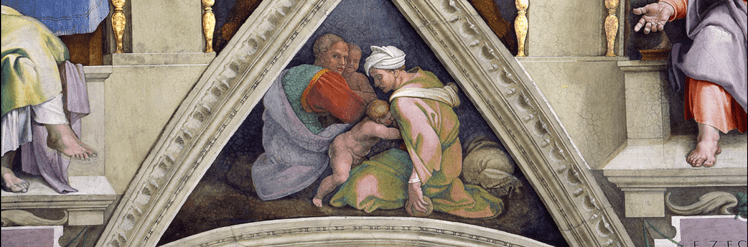
In Leo Steinberg’s recent book about Michelangelo’s paintings (Michelangelo’s Painting: Selected Essays), Steinberg discusses the illustrations of Jesus’ ancestors on the ceiling of the Sistine Chapel. You know the chapter of the New Testament where you read Bob begat Dave, and Dave begat Roger? Well Michelangelo painted most of those named ancestors, though there was almost no information about what their lives were about, and no real precedent for illustrating them this way (including with some of the women of the line). Still, according to Steinberg, Michelangelo knew that the ancestors were believed to have awareness that their descendants would lead directly to the birth of Christ the redeemer.
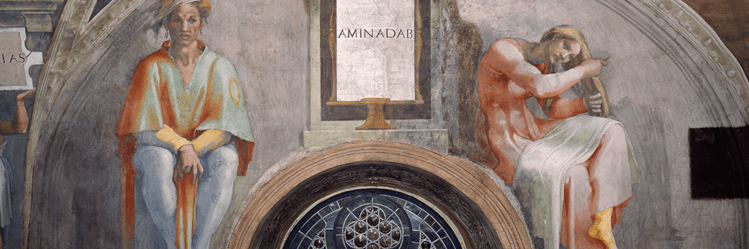
So Steinberg believes Michelangelo portrayed the ancestors in a state of waiting, not knowing when the fruit of their family would result in the birth of Christ. They wait with varying degrees of anxiety, restlessness, boredom perhaps? So these ancestors serve as beautifully illustrated versions of any people awaiting the lifting of darkness. Look here. Do I see myself?
 Bryan K. Alexander
Interesting reflections and questions about waiting and how Michelangelo may have portrayed this in his painting. For most of us, waiting is tedious, unpleasant, even excruciating. Even our computers and microwaves are too slow. Our culture has taught us that instant gratification takes too long! Yet, we spend significant amounts of our lives waiting: in lines, for lunch, for dinner, for vacation, for retirement, for enlightenment, for deliverance. It seems that we can live in resistance to waiting or perhaps embrace waiting as an art. When approached more consciously, I might prefer the words “awaiting” or “abiding” that capture the sense of waiting with a sense of trust or hopeful expectation that what we hope for will arrive, even if we do not know how, when, or through whom. It seems that this is what Michelangelo may have been expressing by painting figures whose progeny would eventually produce Christ.
LikeLike