I Finished Painting the Little Survivor Tree

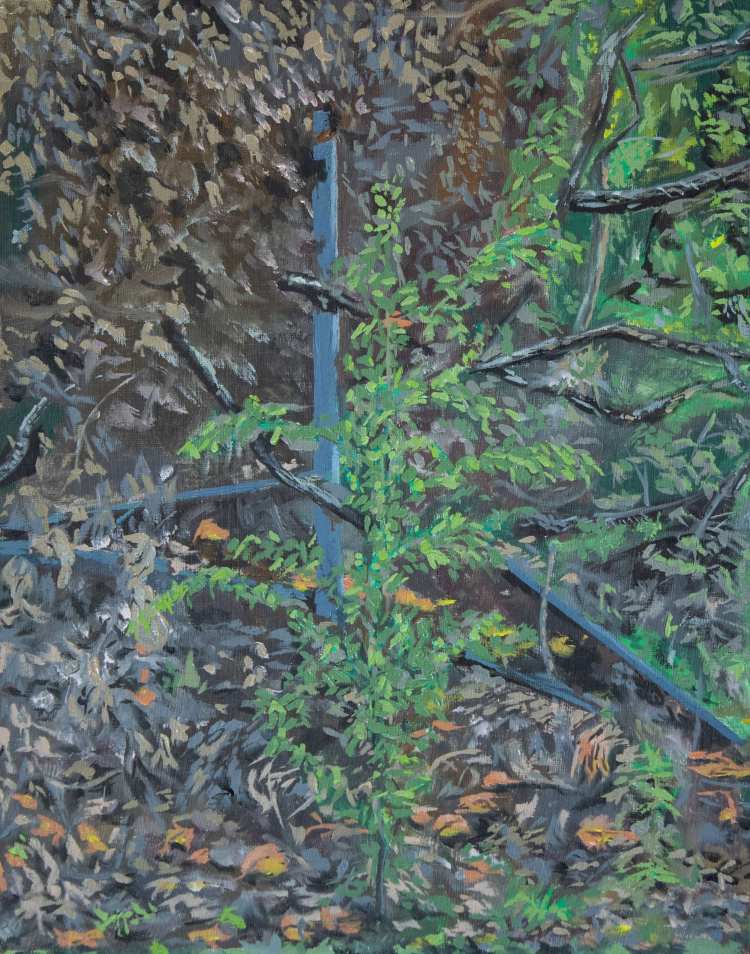
I just wanted you all to be witnesses to the fact that I completed this painting, so here it is.

Yes, it’s a bunch of spots and swipes and dabs, but I assure there is a good bit of drawing in there, somewhere.

Meanwhile, the actual cherry sapling is now in winter mode. It has survived the storm, we think. It has also survived the cleaner-upper folks who stamped around while clearing debris, and also the crew who came and repaired the broken fence.

With respect it should be noted that the cherry sapling has some fiercely protective friends.

Why I’m Painting a Tree After Hurricane Helene


To paint or draw a tree presents so many challenges. For one thing, it’s difficult to see a tree separate from its neighboring trees, and yet you need to depict the tree as distinct in some way. For another, I must ask why I am painting the tree. Why is it important?

Work in progress, a portrait of the cherry sapling that escaped being crushed. Oil on canvas, 11″x14″

I live in Buncombe County, NC, and many people and many many more trees died when Hurricane Helene hit the area. Although at our house, we only suffered the loss of utilities for less than a week, the effect on our wider community has been profound, painful, tiring. So why paint a tree?

The white oak that fell on our fence during Hurricane Helene.

In short, I needed to get back to painting, and I needed to sit in front of something and paint it. And we have this cherry tree that we just planted last spring in the back yard, near the fence. It seemed to be doing well all summer. Then, when Hurricane Helene hit, the wind knocked over a white oak that lived in our neighbor’s yard. The white oak fell and knocked over a pine tree on its way down, and both trees fell onto our fence and damaged it.

And if the white oak or the pine had been a bit taller, they would have killed the young cherry. But the cherry survived. It was not touched. It continues to do well.

So I am painting the cherry, and the process of painting it brings me back to thoughts of what will survive and what won’t, although I don’t have any concrete answers about that.

Autumn fashions, looking in a different direction from the one above.

I find it comforting to sit and carefully observe the cherry tree that survived, as well as the fallen ones nearby. It is also comforting to look at our forests now, with their autumn fashions displayed, and their annual ritual of becoming nude.

One inspiration for this painting is the documentary film El Sol Del Membrillo (also called The Quince Tree Sun, or Dream of Light), which portrays the painter Antonio Lopez Garcia thoughtfully painting a tree with his unique methods. Check it out. (It’s currently free to watch on YouTube, including subtitles in English that you can turn on in the settings.)

Museum Turns Down the Heat on Current Racial Segregation: Review of Gillian Laub’s “Southern Rites” at the Asheville Art Museum

Have you noticed how cool the temperature is in an art museum? That’s because the art is dead there, and if you don’t keep it cool, everything will begin to stink.

The Asheville Art Museum currently exhibits Southern Rites,” by Gillian Laub, a show of photographs about the ongoing racial segregation of a certain place in South Georgia, where a certain kind of onion is the reigning crop. As we learn in one of Laub’s photos, it’s a place where road signs preach to you about God while pitching the glory of their onion burgers.

Laub’s show is a work of photojournalism that exposes that particular place’s racism by focusing on the fact that the schools there held racially segregated proms up until roughly 2010. Not only were there separate proms for white and black students, but students in first grade and up elected a set of black representatives and a set of white representatives for homecoming. As a work of photojournalism, Laub deserves praise for gaining the confidence of the brave people who were willing to speak up and allow themselves to be photographed for publication.

Laub’s disturbing visual story of a white supremacist realm in twenty-first-century America makes for strange viewing in the precise climate of the Asheville Art Museum. I expect art museums, though predictably cool, to bear some relation to the spirit of art—its freedom, its intellectual courage, its passion for truth. My expectation is often disappointed.

I am aware that art museums have financial pressures and political pressures to deal with. Sometimes, things just don’t add up. Laub’s exhibit is one of those times.

Southern Rites” is an intellectual muddle. Although the title, “Southern Rites,” might tell you that its story is one that characterizes the southern United States, Laub admits she focused on only this particular place in South Georgia. No information is provided about the prevalence of racial segregation in any part of society in the South or anywhere else. In a nod to white nationalism’s presence in the North, an exhibit panel weakly states, “the scars of slavery and the legacy of segregation and race-based violence continue to limit the opportunities and hopes of many African American youth in the American South and throughout this country.” In fact, the organized killing of African Americans is not a legacy but a current and active practice far and wide across the country.

Laub knows white supremacy is a violent and current-day practice, and her exhibit includes the story of Norman Neesmith’s killing of 22-year-old Justin Patterson, a friend of several of Laub’s photographic subjects. As a white man who killed a black man, Neesmith served one year in a probation center. By the time the museum patron reaches this part of the exhibit, the climate seems not to be so cool. You’re living in whiteville, the air is stifling, and your legs feel heavy. So when you meet Norman Neesmith, it’s a struggle to remain standing, and your tears are welling.

And yet Laub asks us to focus on the rituals of teenhood in this onioney place, thus the “Rites” part of “Southern Rites.” One exhibit panel coolly begins, “Adolescents participate in elaborate coming-of-age rituals in myriad ways,” a statement that surely rings with the detachment of the anthropologist. She shows us in photos the special fingernail styles, the costumes of celebration, and the dancing. But if this racially segregated prom was a ritual, Laub utterly fails to define her framework for understanding ritual, to describe the ritual’s rules or who enforced or benefited from them. Can we not expect her to explore whether the ritual itself could have served the white residents’ urge to suppress black youth, an urge perhaps rooted in the white community’s ongoing opposition to federally mandated school desegregation? Could she not have explored how the black youth reinterpreted the ritual to serve their own urges?

Most of Laub’s photos are of the black residents of the place, and yet their presence is muted because the black voices are stifled in this exhibit. In the wall tags you will read time and time again the white folks’ ideological view of racial segregation. A white teen proclaims, “If I want to show the rebel flag, I’m going to, because that’s my heritage.” On the other side of the fence, you will read white teen Anna Rich’s statement in a school essay, “I find it ridiculous that the students at our school can find in themselves the barbaric (or, should I say, the pre-Civil War/Rights) mindset to keep the proms segregated.”

The black voices here have no such freedom to assert ideology. The danger to their very bodies reduces them to saying essentially, “We just want to be with our friends,” and, “We just want to stop getting killed.” As a student named Kera says, “It’s stupid that they won’t let us dance together.” And Keyke, looking back on her high school days at age 24, says, “I thought I’d move away for good. But I came back because this is home, and it was too hard to be far from my family. Black Lives Matter and all of the recordings of police brutality and the killing of unarmed Black men has been eye-opening for the country. The rest of the world is finally seeing what we’ve been dealing with forever.”

Laub quotes an elderly woman in a local church as saying, “Life is a lot better than in our cotton-picking days. We knew our place and we stayed in it. Our lives depended on that. Each generation it gets better. But when my cousin Betty’s grandson, Justin Patterson, was killed and the man got off, that was like the old days.” Laub and the “Southern Rites” curators provide no interpretation, but I will: “We have to keep to the place that the white people allow us, or they will kill us.”

Not only do the black voices in the exhibit feel drained of all resistance to injustice, Laub herself seems uninterested in black resistance. She might have tapped into black scholarship and black activism while she was in Georgia, but it seems her reach could not extend to Atlanta, where she might also have found black youth who have fled the place. As a consequence, the strongest ray of defiance to that place’s totalitarian whiteness comes from a small display case featuring Stacey Abrams, Georgia’s voting rights activist and candidate for governor, although Abrams’ fight does not directly bear on the subjects of Laub’s story.

Art museums, including the Asheville Art Museum, can be frigidly cool places. The chill is sometimes deepened when the museum asks things like, “How was the artist using formal elements to convey information in this piece,” when the artwork that they point to describes an incident of cruel and painful injustice, an injustice that, as yet, has barely been answered. The temperature drop in these moments is simply unbearable.

Along with this exhibit, you can buy a coffee table book of Laub’s exhibit photographs in the museum’s gift shop. The asking price is $50.00. If you visit the exhibit, and you’re still standing, and you go to the gift shop and pick up the book to leaf through, be careful. Someone at the front desk may ask you, “Isn’t that a beautiful book?” 

Let’s see how this plays if the exhibit takes up residence in Atlanta.
Michelangelo and the Wait

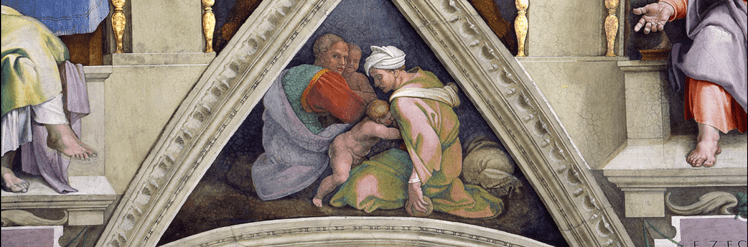
Jesse David Lunette Spandrel, Michelangelo Buonarroti, via screenshot of Vatican Museum web page

First, I would like to offer thanks to the military veterans today, November 11. I am remembering my dad, Milton Alexander, who was a veteran who was stationed in Germany in the 1950’s. He didn’t talk much about his service, but he did frequently remark on the painful amount of waiting around that his service required.

Is the current political situation one of a similar, painful period of waiting? Is the 2020 election about waiting to wake up from a nightmare? Or waiting to wake up from a pervasive darkness, a medieval version of American life? At least one pundit said it’s a particular president who has brought darkness, but I don’t believe he could have done it without help over time.

Azor Lunette, Michelangelo Buonarroti, via screenshot of Vatican Museum web page

If we are in darkness, there’s an interesting assumption there. The assumption is that we know what the light looks like. I’m not so sure we do, in the context of knowing what a fully realized free country looks like.

Also, it’s one thing to know what the light is, but it’s another thing to have the power to turn it on, to bring freedom into being for all.

In Leo Steinberg’s recent book about Michelangelo’s paintings (Michelangelo’s Painting: Selected Essays), Steinberg discusses the illustrations of Jesus’ ancestors on the ceiling of the Sistine Chapel. You know the chapter of the New Testament where you read Bob begat Dave, and Dave begat Roger? Well Michelangelo painted most of those named ancestors, though there was almost no information about what their lives were about, and no real precedent for illustrating them this way (including with some of the women of the line). Still, according to Steinberg, Michelangelo knew that the ancestors were believed to have awareness that their descendants would lead directly to the birth of Christ the redeemer.

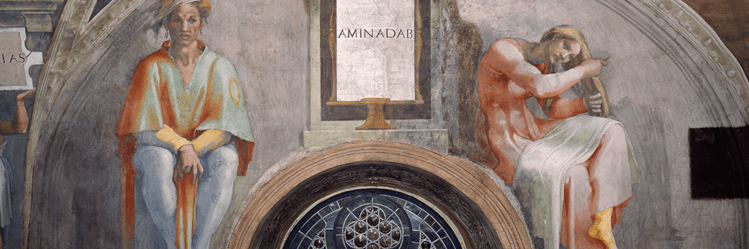
Aminadab Lunette, Michelangelo Buonarroti, screenshot of Vatican Museum web page

So Steinberg believes Michelangelo portrayed the ancestors in a state of waiting, not knowing when the fruit of their family would result in the birth of Christ. They wait with varying degrees of anxiety, restlessness, boredom perhaps? So these ancestors serve as beautifully illustrated versions of any people awaiting the lifting of darkness. Look here. Do I see myself?

It Has Taken So Freaking Long to Get Here

OMG, this big election is approaching, and it’s so important to speak, and yet time and time again I find myself tired physically, bored with the monotonous blaring of the authoritarians, and confused about what my priorities are in speaking at this important moment.

Trust is on my mind. And hope. These are big topics, and I haven’t thought all of it out, so bear with me if I speak incoherently or disjointedly.

We have a trust problem in the USA. In a prior blog post I referred to a problem with daily, interpersonal trust. But now I am talking about something bigger—like trust in the integrity of the coming election, and trust in the vaccine for the coronavirus. If there is not broad trust in these things, then we are in big trouble, because they won’t work.

In order to have a functioning government that tends toward democracy, we need to be able to trust in that government. And in order to trust in that government, we have to be involved with it. We have to take the time to keep an eye on it, tell our representatives when we disagree with their policy decisions, hold them accountable for corruption, lies, and the other bad stuff. We have to be more involved.

I say that as a person who has no time for greater involvement, because I have structured my life as if the government will take care of itself, and I can focus on art and literature after I get done with my job.

I am curious about you, and so consider this question:

Would you prefer that other people take the risk of trusting the election and the vaccine so that you don’t have to do the trusting?

If you know the election process is needed, and the vaccine and its equitable distribution are needed, but you don’t intend to trust it yourself, then are you not hoping to shift the risk to someone else?

There are people who need a democracy, who need a safer place to live, because they don’t have a big bank account they can use to buy their way into a gated community, to buy their way out of the middle of gangland turf battles, to pay for lawyers to be their “fixers.”

Who benefits from the widespread distrust that exists today? —The people who don’t want more voters to vote. The people who benefit from having more control over the government. The people who are wealthy enough not to need the protection of the government, but want to exert the power of the government.

I think that for me, to trust more, I need to be a bit more involved. That’s why I’m helping with getting out the vote. And when a vaccine is ready, I am going to see if I think it seems safe and effective, and then explain why vaccine participation is good for everyone.

These are a few thoughts and questions about trust and hope. I wish this could have been more fully spelled out. Have a good day!

Watch the Eyes Above the Rim of that Mask

Acrylic on canvas self-portrait at 14 work in progress
Picture of myself at 14 capturing my face with a camera. This is an acrylic painting in an unfinished state. I was painting it from a photograph that I took of myself when I was about 14 years old.

I have been studying how to draw and paint human faces over the last several years. I notice I have a need for faces. I need to see a lot of faces every day—see them live and in person, not on a screen. People are wearing masks in public now, and I am staying home a lot, and it interferes with getting my fix of faces. 

Still, the eyes are there. In public places, even with their masks on, the eyes of people are still visible, and the eyes alone have enormous expressive power. If you’re a person who avoids eye contact with strangers in ordinary, non-pandemic circumstances, you might want to consider breaking that habit. If you don’t, you will be missing out on signs, signals, and indications of the life of that masked stranger.

In people’s eyes alone you can see curiosity, fear, mirth, anger. It’s a miracle that all of that communication happens because of a small number of muscles around the eyes and eyelids, combined with the viewer’s unstudied, instinctual understanding of the meanings of tiny, nearly imperceptible eye gestures.

Thank goodness that in painting an expressive portrait, I don’t have to capture an emotion only in a person’s eyes, because the subtlety in the language of eyes may be so great that it is beyond my current powers of art.

Because I am staying home more, I have more time with our cats. We have three cats—two males and one female, who asserts her dominance over the other two. Cats’ faces are very different from ours because they have a lot fewer muscles in their faces, even compared to dogs. Cats’ faces are also covered with fur, which can obscure fine muscle movements. Many people find cats to be unemotional or inscrutable. They simply haven’t learned the feline language of ears and tails, and especially the eyes.

In a way, you could say cats are wearing a mask. They have this condition (lack of musculature) that limits expression in the portion of their faces below their eyes.

So I look in cats’ eyes. Over time I have learned to see those same things that I can see in humans’ eyes: curiosity, fear, mirth, anger. Of course, seeing a cat’s eyes is not always easy. Cats also have to trust you, and they have every reason not to, starting with the fact that you are a lot bigger and stronger than they are. If they don’t trust you, they will not look in your direction while they are experiencing strong emotion, and so you won’t see it.

With regard to what this means for getting along in the pandemic, I would almost say that it takes awhile to learn the language of eyes, whether humans’ eyes or cats’ eyes. But today I feel that we generally already know the language. It is unstudied and instinctual. What we really need is time and trust and patience. We need time to undo our habits of avoiding eye contact. We need time to undo our habits of not trusting even the simple gestures of strangers. We need patience to await the immense rewards of trusting and being trusted.

In Search of Laughs in Flat Rock

Something irrelevant we saw in Flat Rock by a barbecue joint today

In the musical Hamilton it is sung that Mr. Hamilton wrote his way out of every difficulty.  Another way through life is to laugh one’s way across every barrier.

Sometimes, at bedtime with my wife, with the difficulty of sleep at hand, I will make funny faces. Jean will laugh, and she will also laughingly reach out to cover my face and say, “That’s not a good look for you.” This encourages more faces.

I remember going to see the movie The Kings of Comedy the night before I took the graduate school exam. I had been studying pretty hard for it, but I took the general advice to get my mind off of the exam the night before. That movie had me laughing so hard, I was wiping the tears and other fluids off my face long after I left the theater. And I scored well on the exam.

Lately I have felt profoundly tired from the effort of moving from the big city to the mountains. I notice I’m not laughing as much. In addition to the fatigue, the reign of the current pandemic requires me to avoid people. And then there’s the urgent need to move forward in race relations and against domestic violence. For the playground of life I am relegated to the humor that’s available in gifs and memes.

And my face, which under the right conditions can build up great laughter and accompanying fluids, I must keep shut behind a mask.

Remember that study that showed children laugh about 100 times more per day than adults do? When I heard about it, I felt really sad about that study, and I made a very adult resolution to laugh more. But then something happened, and I forgot. Probably something very serious, like I had to take out the trash or wash a dirty dish. 

Fortunately I have people like Brian, Margaret, and Jean, whom I had the pleasure of hanging out with today, over in Flat Rock. Brian gets me laughing well, these days. He can take any stumble in conversational speech and turn it into a pirouette of wit.

I am also finding wonderful laughs in Marcel Proust’s writing. In Swann’s Way, a young character arrives as a guest for dinner in a solidly middle-class home. The host notices that the guest’s clothes are wet. He asks the guest if it has rained. The guest replies,

“Sir, I am absolutely incapable of telling you whether it has rained. I live so resolutely apart from physical contingencies that my senses no longer trouble to inform me of them.”

I think Proust was another one of those who wrote his way out of every difficulty. And he wrote himself some laughs, too.

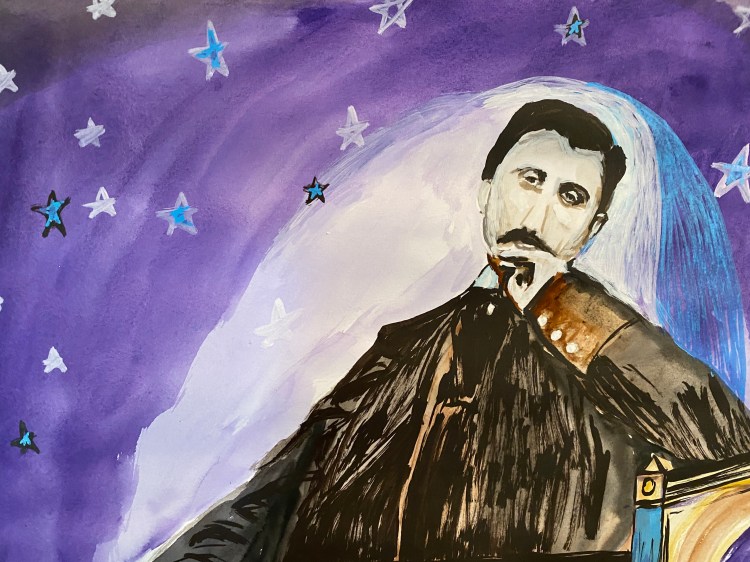
Mixed media drawing of Marcel Proust looking sleepy
My cartoon of an insomniac Proust

Writing and Derring-Do

Do you ever have the feeling that persisting with certain writing projects is like walking on a high-wire?

Maybe you hear that old Leon Russell song in your head: “I’m up on the tight wire/ One side’s ice and one is fire.” (“Tight Rope,” 1972.)

The parallels between writing and wire-walking are what draw me to the wire-walker named Philippe Petit. He was the subject of the film Man on Wire (Magnolia Home Entertainment: 2008), which recounted Petit’s extraordinary feat of walking a high-wire that he had illegally stretched between the towers of the World Trade Center in 1974. Petit wrote about the adventure in The Walk (Skyhorse: 2015).

What are the parallels between writing and wire-walking? Writing frequently requires deep and prolonged concentration under the pressure of a deadline. In Man on Wire you see numerous shots of Petit in complete absorption, his face an “ageless mask,” as someone in the film describes it. Break the concentration and disaster may follow. Logic broken. Deadline missed.

Writing is also a performance, and sometimes a feat of derring-do. Malcolm Gladwell, in David and Goliath (Little, Brown: 2013), described how two different parents responded to the murders of their children. In one case, a failed experiment in criminal justice reform was the result. In the other case, an experience of peace and sanity despite the long odds of healing. How do you take two people who have suffered one of the most profound kinds of human loss, and compare their journeys? For Gladwell, with a reputation for seriousness, he took a great risk of seeming crass and produced a worthy essay.

Philippe Petit was certainly daring and skilled. Before he wire-walked the World Trade Center, he wire-walked between two monumental pylons of the Sydney Harbour Bridge. Before that, he wire-walked the towers of the Cathedral of Notre Dame in Paris. He was a man of derring-do.

One thing lacking in those performances was the taking of a different type of risk: the risk of being ignored. Petit had failed to get hired by the circuses. He performed his very public feats with the lowest risk of being ignored, perhaps in part because he couldn’t stand that peculiar torment. And wasn’t it the fear of that torment that led him to conclude repeatedly that he must risk life and limb in his art? That working at “the edge” meant working in close proximity to his own death?

In my experience, the writer frequently risks being ignored. The writer builds a house of words, but no one really needs to live there. There are plenty of books already in the library. Plenty of magazines, and plenty of websites. Unread books, unexposed to a readership, do not have squatters. Perhaps lack of exposure is not deadly like falling from the high-wire can be. More like a chronic wasting.

Another fascination about Philippe Petit: He is also a writer. The Walk will have an audience for some time to come given the immensity of his World Trade Center feat and the subsequent history of the WTC. But is there an audience for Why Knot? (Harry N. Abrams: 2013). In the age of Velcro, zip-ties, and all sorts of other technologies for binding, Petit has written a book about tying knots in ropes. He has an understandable passion for knots, given that wire-walking depends on being able to tie knots that are so secure, you can turn over your life to them. Two knots and a notion are all that keep him from death.

Salutations to Petit for leaving the high-wire long enough to build a little house of words.